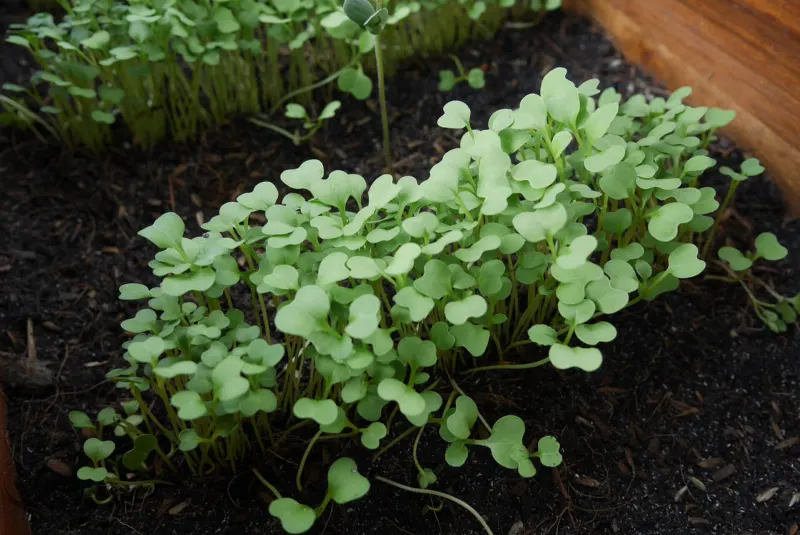
Most problems with microgreens have three causes: too much water, too little light and poor airflow. The good news is that the growing cycle is short, so every mistake can be fixed with the next sowing. Here are the most common problems and what to do about them.
Mould or root hairs?
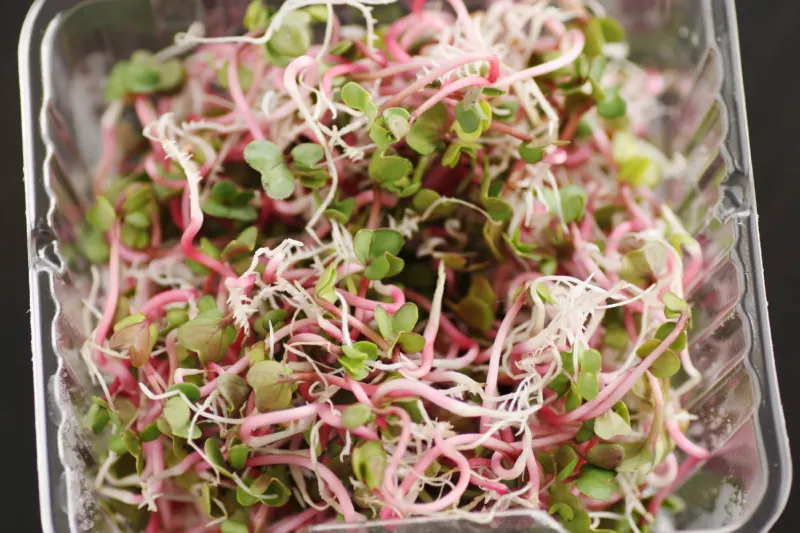
This is the question beginners ask most. A few days after sowing, many varieties, especially radish, broccoli and the other brassicas, grow a white, fuzzy "cotton" around their roots. Most of the time this is not mould but root hairs: tiny extensions of the root that help it absorb water. They are completely normal.
| Root hairs (normal) | Mould (a problem) | |
|---|---|---|
| Where it appears | Only on the roots, evenly across the tray | In patches, over seeds, medium and stems |
| Appearance | White, fine, fuzzy, growing from each root | Cobweb-like, white or grey, spreading |
| When misted with water | Collapses and almost disappears | Stays, turns slimy |
| Smell | None, or earthy | Musty, stale |
The simplest test is misting: if the white fuzz disappears with a little water, it is root hairs.
Mould
Causes: overwatering, still air with no circulation, sowing too densely, high temperature and humidity, dirty trays.
What to do: If the mould is a small patch caught early, remove it together with the medium around it and improve airflow. If it has spread or reached the leaves, throw out the whole tray. Do not eat microgreens from a tray with widespread mould.
Prevention:
- Water from below and empty any excess water after about 30 minutes.
- Put a small fan on a low setting near the trays.
- Do not sow more densely than needed: seeds should touch, not sit on top of each other.
- Wash trays in hot soapy water before every sowing.
Rot at the base (seedlings collapse)
If a group of seedlings suddenly falls over, with stems softening and darkening just above the medium, it is usually a fungal seedling disease known as damping off. It is encouraged by the same things as mould: too much water and poor airflow. Collapsed seedlings cannot be saved. If the problem is spreading, throw out the tray and clean it thoroughly.
Weak, tall seedlings that lean
When seedlings come up long, thin, pale green and all leaning the same way, they are short of light. This happens often in winter on a windowsill. Move them to the brightest spot in the house, turn the tray daily, or use an LED grow light a few centimetres above it. A little stretching during the dark days is intended. Once they are in the light, though, the plants should firm up.
Yellow leaves
Leaves that are yellow straight after the blackout period are normal: they have not made chlorophyll yet. They will turn green within a day or two in the light. If they stay yellow, there is not enough light.
Patchy or poor germination
- Seeds were not touching the medium. Use a weighted cover for the first days.
- Uneven spread. Scatter the seed from a little higher, in two passes.
- The medium dried out in the dark. Check the weight of the tray every day.
- Large seeds not soaked. Pea and sunflower germinate much better if soaked first.
- Old seed or the wrong temperature. Most seeds germinate well at around 20–24 °C.
Seed hulls stuck on the leaves
Sunflower and beet often lift the seed coat on their first leaves. A weighted cover in the first days helps the plants shed it as they push upwards. Anything left comes off with a light shake or when you rinse them before eating.
Bitter or very strong taste
If you leave them too long and many true leaves develop, the flavour gets stronger and the texture tougher. Cut when the cotyledons have fully opened. Some varieties, such as mustard and radish, are naturally hot anyway.
For the basic method, see how to grow microgreens at home. For hygiene, see the storage and food safety guide.
Sources
- Utah State University Extension, Grow Your Own Microgreens.
- Penn State Extension, The ABCs of Microgreens.
- Riggio GM, Wang Q, Kniel KE, Gibson KE. Microgreens—A review of food safety considerations along the farm to fork continuum. International Journal of Food Microbiology, 2019.