You will often read that microgreens have "40 times more nutrients" than mature vegetables. The reality is more interesting, but also more nuanced. Below we sum up what researchers have actually measured and how to read the numbers.
The USDA vitamin study (2012)
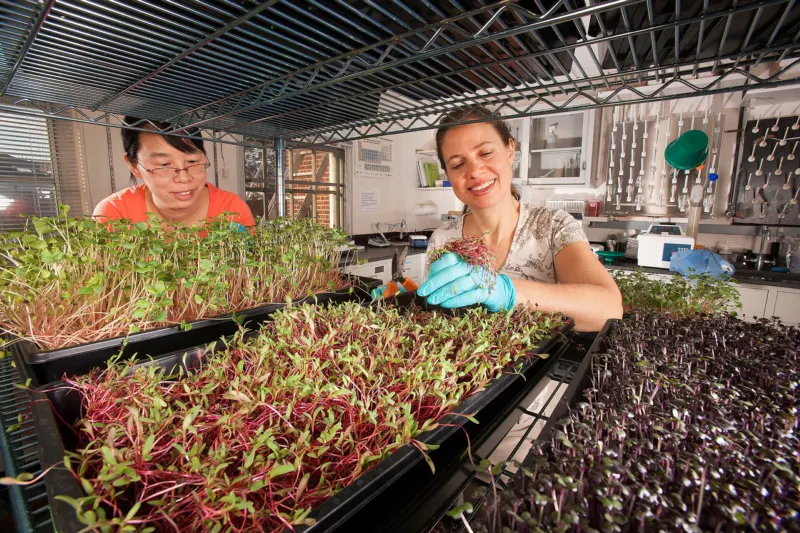
The first major study was carried out by researchers at the US Department of Agriculture (USDA) and the University of Maryland. They measured vitamin C, three carotenoids, vitamin K1 and vitamin E in 25 commercially grown microgreens. The main findings:
- Vitamin C: from 20.4 to 147.0 mg per 100 g fresh weight, depending on the variety.
- Beta-carotene: from 0.6 to 12.1 mg/100 g. Lutein/zeaxanthin: from 1.3 to 10.1 mg/100 g. Violaxanthin: from 0.9 to 7.7 mg/100 g.
- Compared with USDA database values for mature leaves, the microgreens generally had higher concentrations, about five times higher on average.
Four varieties stood out, each in a different category:
| Nutrient | Highest in the study |
|---|---|
| Vitamin C | Red cabbage |
| Carotenoids | Coriander (cilantro) |
| Vitamin K1 | Amaranth (garnet variety) |
| Vitamin E | Green daikon radish |
The mineral study (2016)
In a second study, USDA researchers analysed nine minerals in 30 varieties, mostly from the cabbage family (Brassica), such as arugula, broccoli, kale and radish:
- The most abundant mineral was potassium, followed by phosphorus, calcium, magnesium and sodium.
- Savoy cabbage had the most calcium, at 98 mg/100 g, and peppercress the least, at 39 mg/100 g.
- Purple kohlrabi had 0.75 mg of iron per 100 g.
- Wasabi had the most potassium and daikon radish the least.
More recent studies, summarised in a 2025 review, also show that broccoli microgreens contain more magnesium, manganese, copper and zinc than mature broccoli.
How to read the numbers
1. Differences between varieties are large. There is no single "microgreens value". Red cabbage and radish differ from each other as much as mature vegetables do.
2. Growing method matters. Light, medium, feeding, harvest timing and storage all change the values. The USDA researchers themselves note that more research is needed.
3. The amount you eat matters. Values are given per 100 grams, while a handful of microgreens weighs about 20–30 grams. An example: 25 g of red cabbage microgreens, at the highest value in the study (147 mg/100 g), provides about 37 mg of vitamin C. That is almost half the EU daily reference intake (80 mg). It is a worthwhile addition, but it does not replace a portion of vegetables or fruit.
4. Big multipliers need care. The "4 to 40 times" figure you see refers to specific nutrients in specific varieties, not to microgreens in general.
What we know about health benefits
Here the research is still at an early stage. According to a recent review, most studies of health effects have been done in animals or on cells in the lab, and studies in people are very few. For example, red cabbage microgreens lowered "bad" cholesterol in mice on a high-fat diet. Findings like this are encouraging, but they do not prove the same happens in people.
The safe conclusion: microgreens are a nutritious, tasty vegetable that adds variety to your diet. They are not a medicine, nor a "superfood" that cures anything.
See also the difference between microgreens, sprouts and baby greens and all microgreen varieties.
Sources
- Xiao Z, Lester GE, Luo Y, Wang Q. Assessment of vitamin and carotenoid concentrations of emerging food products: edible microgreens. Journal of Agricultural and Food Chemistry, 2012; 60(31): 7644–7651.
- USDA Agricultural Research Service, Specialty Greens Pack a Nutritional Punch (2014).
- USDA Agricultural Research Service, Which Minerals Are in Microgreens? (2017), on Xiao et al., Journal of Food Composition and Analysis, 2016.
- Kaya S, Yardımcı H. Microgreens: nutritional properties, health benefits, production techniques, and food safety risks. PeerJ, 2025.
- Regulation (EU) No 1169/2011, Annex XIII: nutrient reference values.