
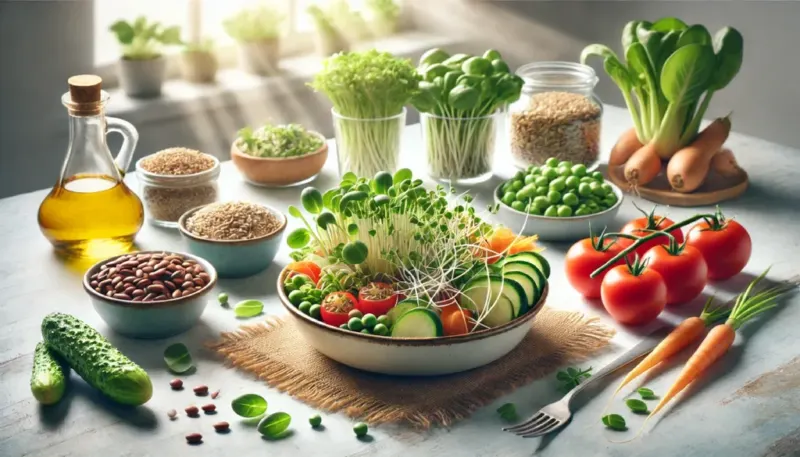
Microgreens are not a supplement or a "superfood". They are vegetables, and their value is practical: they make it easy to add a little green to almost any dish, with no cooking and no effort. This guide explains how to fit them into everyday eating.
How much to eat
There is no "recommended dose" for microgreens. A sensible portion is a handful, about 20–30 grams. The World Health Organization recommends at least 400 grams of fruit and vegetables a day in total. Microgreens count towards that, but do not replace it: a handful of microgreens is an addition to a plate of vegetables, not a substitute for one.
Ideas for every meal
Breakfast
- On eggs (omelette, poached, boiled) or on avocado toast.
- In a fruit smoothie: broccoli and spinach barely change the flavour.
Lunch
- As a salad base, with sunflower and pea for bulk and crunch.
- In sandwiches, pittas and wraps, in place of lettuce.
- In bowls with grains, pulses and vegetables.
Dinner
- On soups, risotto, pasta or grilled fish, on the plate just before serving.
- In a quick stir-fry: pea shoots handle 30–60 seconds in the pan.
Raw or cooked?
Preferably raw. Vitamin C is destroyed by heat. In brassicas such as broccoli and radish, the enzyme that converts glucosinolates into sulforaphane is also lost in cooking. If you add them to hot food, put them on the plate rather than in the pot.
Smart pairings
- Iron + vitamin C: iron from plant foods such as pulses and leafy greens is absorbed better with vitamin C. A lentil salad with red cabbage and lemon is a good example.
- Carotenoids + fat: carotenoids are absorbed better with a little fat. A little olive oil, avocado or nuts in the salad is enough.
- Variety: each variety has a different "profile". Mixing varieties from different families gives more variety than a large amount of one.
For children
Mild varieties such as pea, sunflower and kohlrabi often appeal even to children who do not take easily to "greens". Growing them at home is also a nice, quick experiment: children see results within days and are more willing to eat something they grew themselves.
Cost
Ready-made microgreens are expensive per kilo. At home they cost very little: according to Utah State University, seed for a 25×50 cm tray costs, depending on the variety, from under one to about two US dollars. See how to grow them.
Sources
- World Health Organization, Healthy diet.
- Utah State University Extension, Grow Your Own Microgreens.
- Xiao Z, Lester GE, Luo Y, Wang Q. Assessment of vitamin and carotenoid concentrations of emerging food products: edible microgreens. Journal of Agricultural and Food Chemistry, 2012.