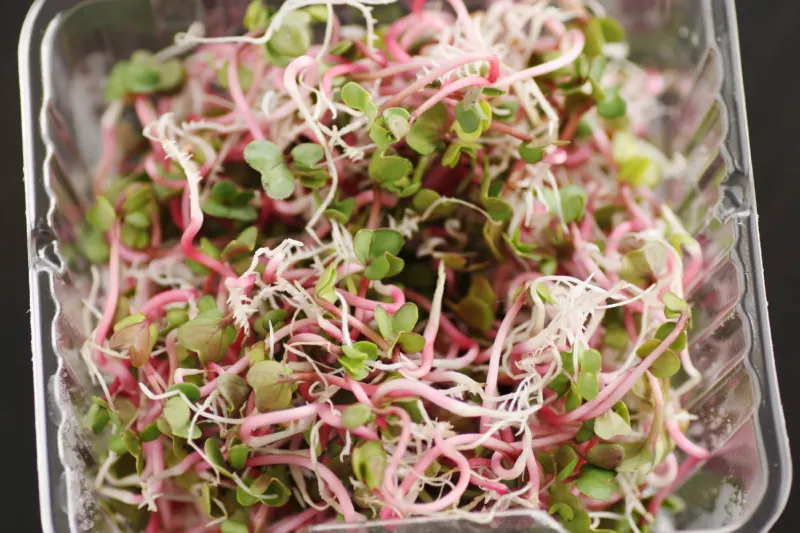
On shelves and menus the three names are often mixed up. In fact they are the same plant at three different stages of growth. The difference is not just size: the growing method changes, as do the part of the plant you eat, the flavour and, above all, how safe it is to eat raw.
Sprouts
Sprouts are seeds that have only just germinated. They are grown in water or a damp environment, usually in the dark and without soil, and are ready within a few days, roughly 3 to 5. You eat the whole thing: seed, root and the small shoot. Familiar examples are mung bean ("bean sprouts"), alfalfa and radish sprouts.
Microgreens
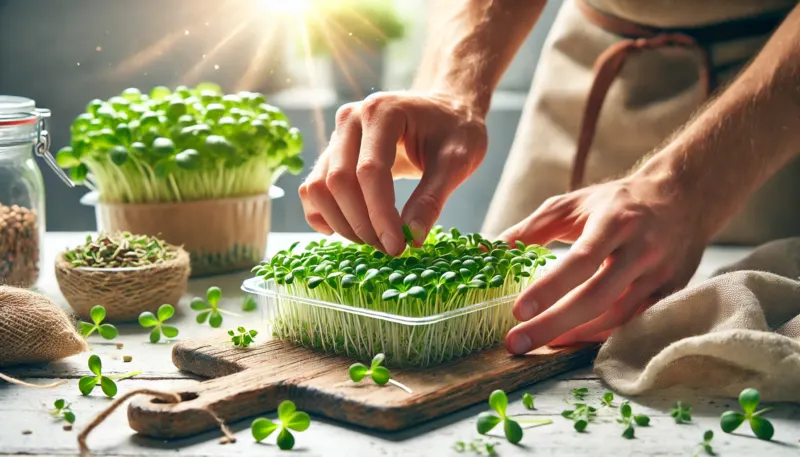
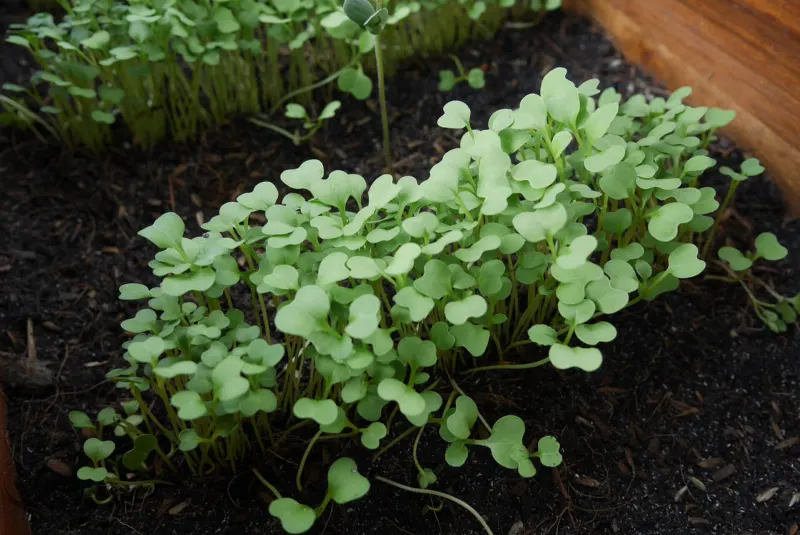
Microgreens are grown in a medium such as soil or coconut coir, and they grow in light. They are harvested when the cotyledons (the first two leaves) are fully developed and the first true leaves are starting to appear. That is usually 7 to 14 days after germination, though some slow varieties need up to three weeks. They stand about 2.5 to 7.5 cm tall.
The key difference from sprouts: microgreens are cut above the growing medium. You eat only the stem and leaves, not the root or the seed. Because they grew in light, they have developed colour and a stronger, more distinctive flavour.
Baby greens
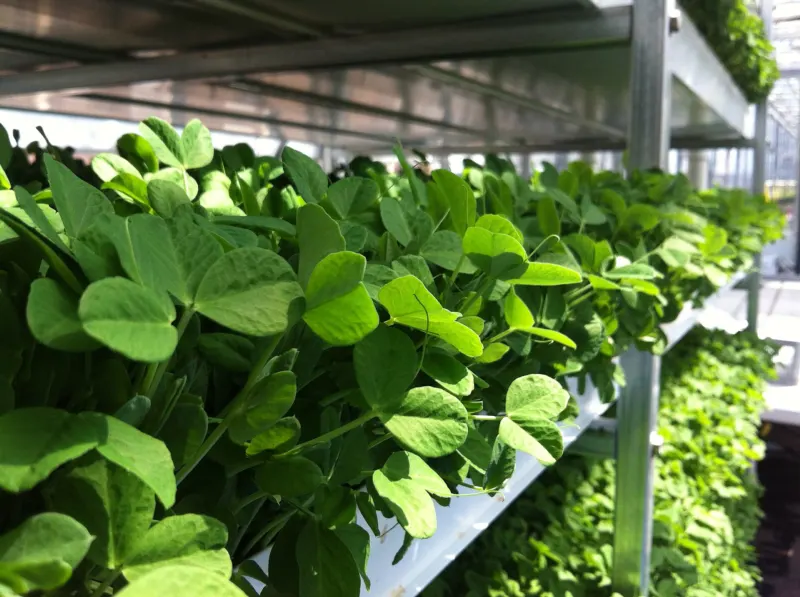
Baby greens are the next stage: plants left to grow a few more weeks, until their true leaves are big enough for a salad. Baby spinach and baby rocket in supermarket bags are the best-known examples. They are usually grown in fields or greenhouses, and only the leaves are eaten.
Comparison table
| Sprouts | Microgreens | Baby greens | |
|---|---|---|---|
| Time to harvest | About 3–5 days | Usually 7–14 days (up to 21) | Several weeks |
| Growing method | In water, often in the dark | In a medium, with light | In soil, field or greenhouse |
| What you eat | Everything: seed, root, shoot | Stem and leaves, cut above the medium | Leaves only |
| Flavour and texture | Crunchy, mild | Intense, concentrated flavour | Milder, like small lettuce |
| Main use | Salads, sandwiches, Asian cooking | Garnish, salads, sandwiches, smoothies | Salads |
Nutrition
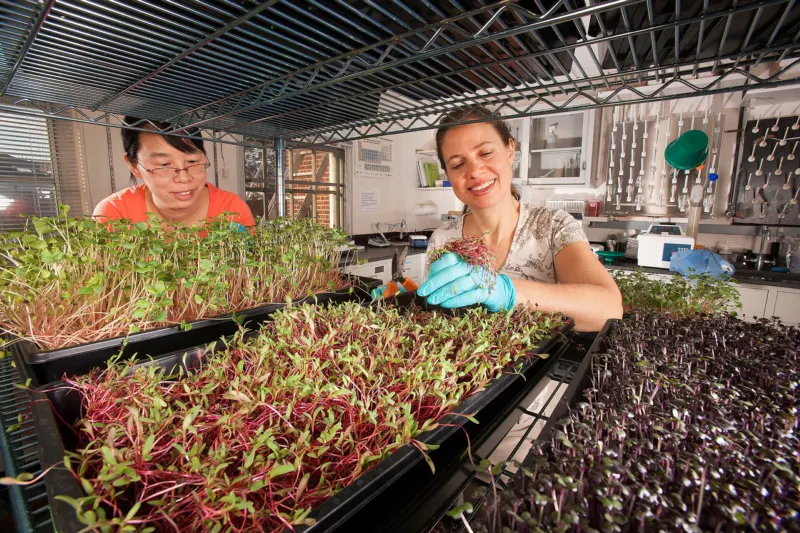
The best-known study on this comes from the US Department of Agriculture (USDA). Researchers measured vitamins and carotenoids in 25 microgreen varieties and compared them with database values for the mature leaves of the same plants. In most cases the microgreens had higher concentrations, about five times higher on average, though with large differences from one variety to another.
That does not mean a handful of microgreens replaces a plate of vegetables. They are eaten in small amounts, so their overall contribution to a meal is smaller than the per-100-gram comparison suggests. There is more in our guide to what the research says about their nutrition.
Safety: why sprouts need more care
Sprouts grow in warm, damp conditions, the same conditions that favour bacteria such as Salmonella and E. coli. Bacteria can even be inside the seed, where washing cannot reach. That is why the US Food and Drug Administration (FDA) advises people at higher risk, meaning children, older adults, pregnant women and anyone with a weakened immune system, not to eat raw or lightly cooked sprouts of any kind.
Microgreens grow in light and air, and only the part above the medium is eaten. According to a 2020 scientific review, they had not been linked to any foodborne illness outbreaks up to then, although there had been product recalls. That does not make them sterile: the same hygiene rules apply as for any raw vegetable. See the storage and food safety guide.
Which should you choose?
- For strong flavour and colour in a small amount: microgreens.
- For volume in a salad: baby greens.
- For crunch in cooked dishes: sprouts, preferably cooked.
- For growing at home: microgreens are the easiest and safest choice. See how to grow them step by step.
Sources
- Xiao Z, Lester GE, Luo Y, Wang Q. Assessment of vitamin and carotenoid concentrations of emerging food products: edible microgreens. Journal of Agricultural and Food Chemistry, 2012; 60(31): 7644–7651.
- USDA Agricultural Research Service, Specialty Greens Pack a Nutritional Punch (2014).
- Penn State Extension, The ABCs of Microgreens.
- U.S. Food and Drug Administration, Selecting and Serving Produce Safely.
- Kaya S, Yardımcı H. Microgreens: nutritional properties, health benefits, production techniques, and food safety risks. PeerJ, 2025.
- Turner ER, Luo Y, Buchanan RL. Microgreen nutrition, food safety, and shelf life: A review. Journal of Food Science, 2020; 85(4): 870–882.
Photo: Stacy Spensley, Wikimedia Commons, CC BY 2.0.