
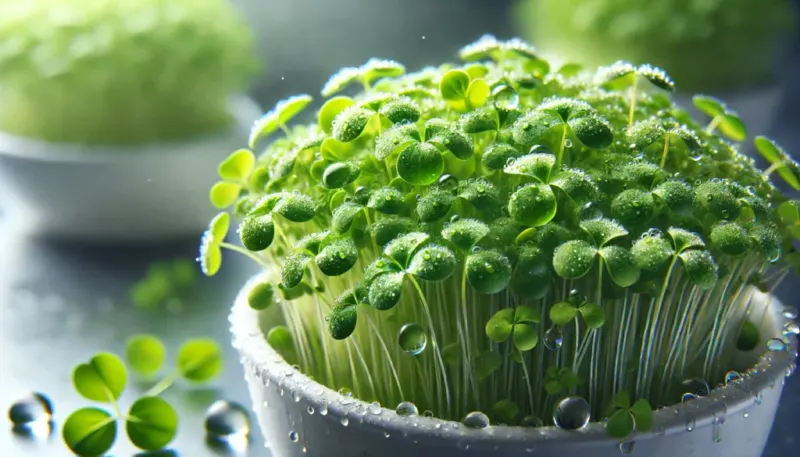
Online you will read that microgreens "boost the immune system", "prevent osteoporosis", "lower cholesterol" and "detox". Some of this has a basis, some does not. On this page we separate what is known from measurements and studies, what is plausible but unproven, and what has no support at all.
What we know with reasonable confidence
1. They are vegetables, and vegetables are good for you
The surest benefit is also the simplest. The World Health Organization recommends at least 400 grams of fruit and vegetables a day for everyone over 10. Most people eat less. Microgreens are an easy, tasty way to add a little more green to dishes that otherwise would have none.
2. They are nutrient-dense
The USDA study of 25 varieties found that, per 100 grams, microgreens generally had more vitamins and carotenoids than the mature leaves of the same plants, about five times more on average. For example, red cabbage had up to 147 mg of vitamin C per 100 g. A second USDA study found they are good sources of potassium and calcium.
3. They contain plant compounds under intense study
Brassicas such as broccoli and radish contain glucosinolates, which are converted into compounds such as sulforaphane. Coloured varieties contain pigments such as anthocyanins and betalains. These compounds are being studied for antioxidant and anti-inflammatory effects, mostly in the lab.
What is encouraging, but unproven in people
- Cholesterol: in mice on a high-fat diet, red cabbage microgreens lowered LDL ("bad") cholesterol and markers of inflammation.
- Weight and blood sugar: broccoli microgreen juice improved weight and insulin sensitivity in obese mice.
- Cancer cells: extracts of brassica microgreens reduced the growth of colon cancer cells, but in a test tube.
According to a 2025 review, almost all studies of health effects have been done in animals or on cells, and studies in people are very few. What happens in a mouse or a dish often does not happen in humans, or happens only at far higher amounts than we eat.
What has no evidence behind it
- "Detox": the body removes toxins through the liver and kidneys. No food has been shown to speed this up.
- "Boosting the immune system": vitamins such as C are needed for the immune system to work normally. But if you already get enough, extra does not "boost" it.
- "Preventing disease": no study has shown that microgreens prevent any specific disease in people.
- "40 times more nutritious": this refers to specific nutrients in specific varieties, not microgreens in general.

Who should take care
- People on blood thinners (e.g. warfarin): many microgreens, especially amaranth, contain vitamin K. The amount should stay consistent.
- People on a potassium-restricted diet, for example because of kidney disease: potassium is the most abundant mineral in microgreens.
- People prone to kidney stones: spinach and beet, in their mature form, are high in oxalates.
- Pregnant women, young children, older people and anyone immunocompromised: the general caution for any raw vegetable applies. See the storage and food safety guide.
If you have a medical condition or take medication, discuss changes to your diet with your doctor. This page is for information and does not replace medical advice.
The bottom line
Microgreens are a nutritious, tasty and easy vegetable. Their value is that they make it easier to eat more, and more varied, greens, not that they work miracles. For the details, see our guide to what the research says.
Sources
- World Health Organization, Healthy diet.
- Xiao Z, Lester GE, Luo Y, Wang Q. Assessment of vitamin and carotenoid concentrations of emerging food products: edible microgreens. Journal of Agricultural and Food Chemistry, 2012; 60(31): 7644–7651.
- USDA Agricultural Research Service, Which Minerals Are in Microgreens? (2017).
- Huang H, et al. Red Cabbage Microgreens Lower Circulating Low-Density Lipoprotein (LDL), Liver Cholesterol, and Inflammatory Cytokines in Mice Fed a High-Fat Diet. Journal of Agricultural and Food Chemistry, 2016.
- Kaya S, Yardımcı H. Microgreens: nutritional properties, health benefits, production techniques, and food safety risks. PeerJ, 2025.