
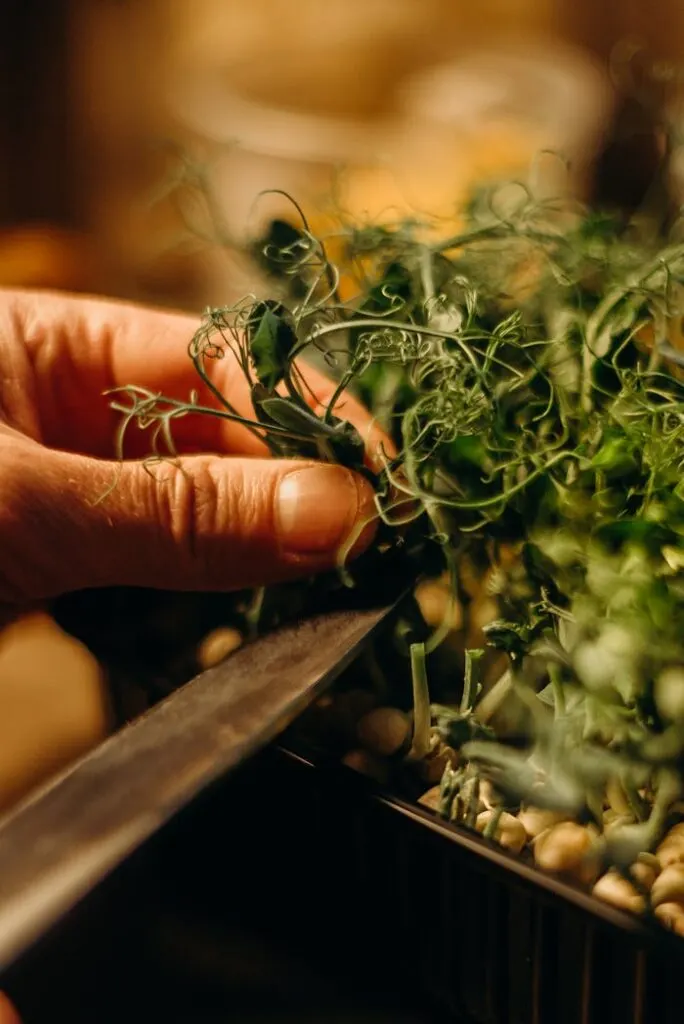
Definition
Microgreens are the young plants of vegetables and herbs, cut very early: once the cotyledons, the first two leaves that emerge from the seed, have fully opened, and often just as the first true leaves begin to appear. For most varieties that is 7 to 14 days after germination, at a height of about 2.5 to 7.5 cm.
"Microgreens" is a marketing term, not a botanical one. They are not separate plants but a growth stage of familiar ones: broccoli, radish, pea, sunflower, basil, coriander and dozens more.
Where they came from
According to the US Department of Agriculture (USDA), microgreens started appearing on chefs' menus in San Francisco as early as the 1980s. At first they were mainly a garnish for fine dining, valued for their colour, texture and intense flavour. Today they are sold in supermarkets and farmers' markets, and many people grow them at home.
Microgreens, sprouts and baby greens
The three are often confused. Sprouts are grown in water, usually in the dark, and eaten whole, seed and root included, after just a few days. Microgreens grow in a medium and in light, and are cut above the root. Baby greens, such as baby spinach, are left to grow a few more weeks. The difference matters for safety too. See the detailed guide to microgreens, sprouts and baby greens.
The main families
- Cabbage family (Brassicaceae): broccoli, radish, red cabbage, kohlrabi, arugula, mustard. Easy and fast, with flavours from mild to hot.
- Legumes (Fabaceae): pea. Sweet, crunchy and filling.
- Daisy family (Asteraceae): sunflower, milk thistle. Fleshy leaves, nutty flavour.
- Amaranth family (Amaranthaceae): amaranth, beet, spinach. Vivid colours, mild flavours.
- Carrot family (Apiaceae): carrot, coriander. Aromatic and slow.
- Grasses (Poaceae): wheatgrass. Mainly for juicing.
See all microgreen varieties with photos.
How they are grown
The basic method is simple: a shallow tray, a few centimetres of growing medium, thick sowing, a few days in the dark, then plenty of light and watering from below. No fertiliser, garden or special equipment is needed. A bright window or a simple LED light is enough. The home growing guide explains it step by step, with amounts and timings for each variety.
Nutritional value
The best-known study, by the USDA in 2012, measured vitamins and carotenoids in 25 microgreen varieties and found generally higher concentrations than in the mature leaves of the same plants, about five times higher on average. But differences between varieties are large, and we eat microgreens in small amounts. See what the numbers really mean in our guide to what the research says, and a nutrient-by-nutrient summary on the Nutritional Value page.
How to eat them
Mostly raw: in salads, sandwiches, wraps, smoothies, and as a garnish on soups, eggs, fish and pasta. The sturdier ones, such as pea, also stand up to a quick stir-fry. You will find more ideas on the Gastronomy page, and on everyday eating on the Diet page.
Storage
Microgreens are delicate: they need the fridge, at 4 °C or below, should be stored dry and unwashed, and rinsed just before eating. At home they usually keep from a few days to a week. All the details are in the storage and food safety guide.
Sources
- USDA Agricultural Research Service, Specialty Greens Pack a Nutritional Punch (2014).
- Xiao Z, Lester GE, Luo Y, Wang Q. Assessment of vitamin and carotenoid concentrations of emerging food products: edible microgreens. Journal of Agricultural and Food Chemistry, 2012; 60(31): 7644–7651.
- Penn State Extension, The ABCs of Microgreens.