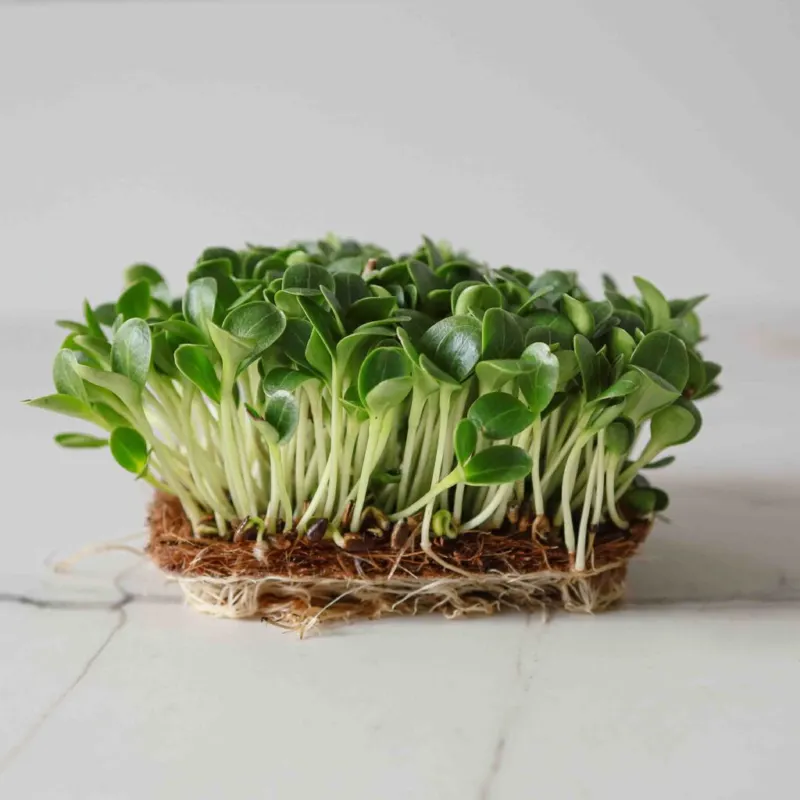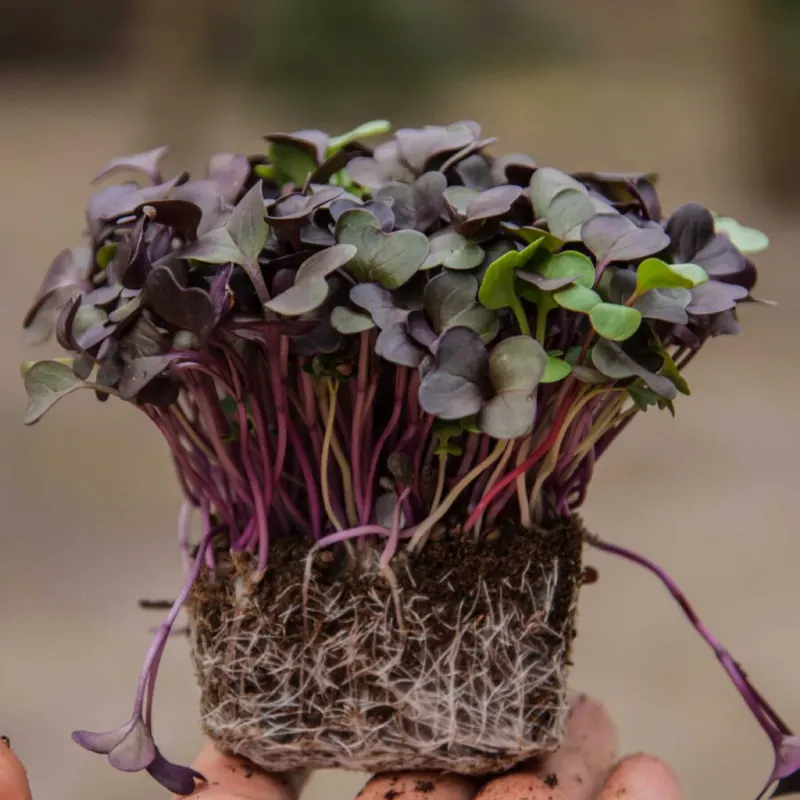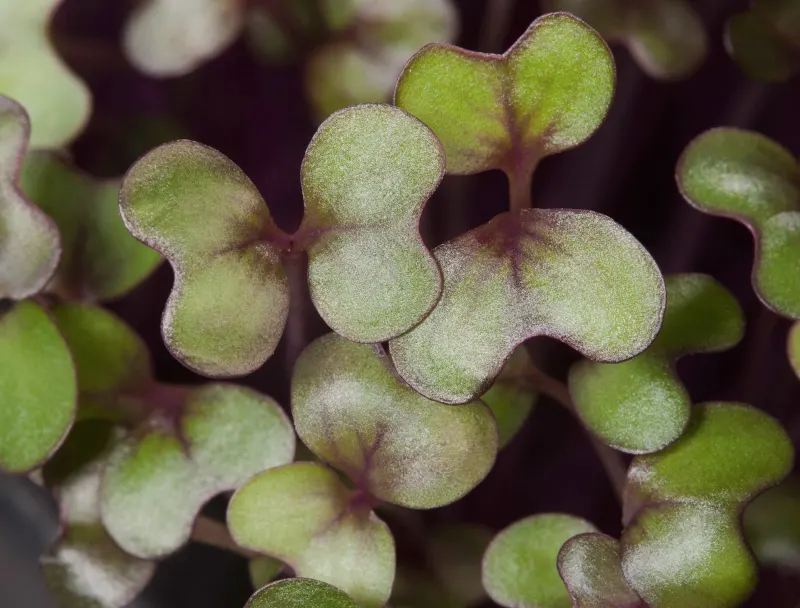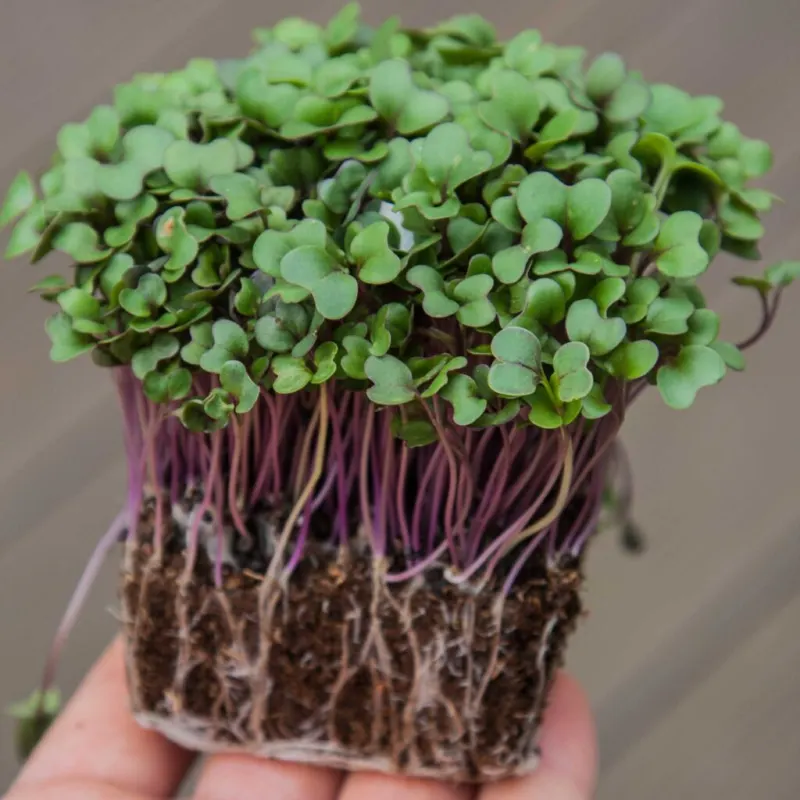
Kohlrabi is the cabbage with the swollen, round stem. As a microgreen, though, it looks nothing like the mature plant: it produces thin purple stems, in the red variety, and two green heart-shaped leaves. Its flavour is one of the mildest in the cabbage family, fresh and slightly sweet, without the bite of radish or mustard.
At a glance
| Botanical name | Brassica oleracea var. gongylodes |
|---|---|
| Family | Cabbage family (Brassicaceae) |
| Flavour | Mild, sweet, cabbage |
| Colour | Purple stems, green leaves |
| Presoak | Not needed |
| Days in the dark | 2–3 |
| Harvest | About 8–12 days |
| Difficulty | Easy |
What the research says
In the USDA study of minerals in 30 microgreen varieties, purple kohlrabi microgreens had 0.75 mg of iron per 100 g fresh weight. The researchers highlighted them as a good addition for people who want more iron in their diet.
To put that in proportion: the EU daily reference intake for iron is 14 mg. A 25 g handful provides about 0.2 mg, a small but real contribution. Iron from plant sources is absorbed better when eaten with vitamin C, for example with lemon, peppers or red cabbage.
Recent studies, summarised in a 2025 review, have also shown that nutrients in kohlrabi change with light and growing medium. For example, iron, magnesium and calcium rose under orange light of a specific wavelength, and natural media such as peat gave better results than synthetic mats. See our guide to what the research says.
Growing
- Sow: dry seed, thickly, on a moist medium. For a 25×50 cm tray, about 25–30 g, like other brassicas.
- Darkness: 2–3 days under a cover with a light weight.
- Light: strong light for deep purple stems.
- Harvest: in about 8–12 days, once the cotyledons have fully opened.
Like all brassicas, it grows lots of white root hairs in the first days: see how to tell them from mould.
In the kitchen
- Salads: their mild flavour goes with almost anything.
- Sandwiches and wraps: in place of lettuce.
- On soups and vegetable purées: for colour and freshness.
- For children: one of the few microgreens with no bite, so a good start for young eaters.
Sources
- USDA Agricultural Research Service, Which Minerals Are in Microgreens? (2017).
- Kaya S, Yardımcı H. Microgreens: nutritional properties, health benefits, production techniques, and food safety risks. PeerJ, 2025.
- Utah State University Extension, Grow Your Own Microgreens.
- Regulation (EU) No 1169/2011, Annex XIII: nutrient reference values.