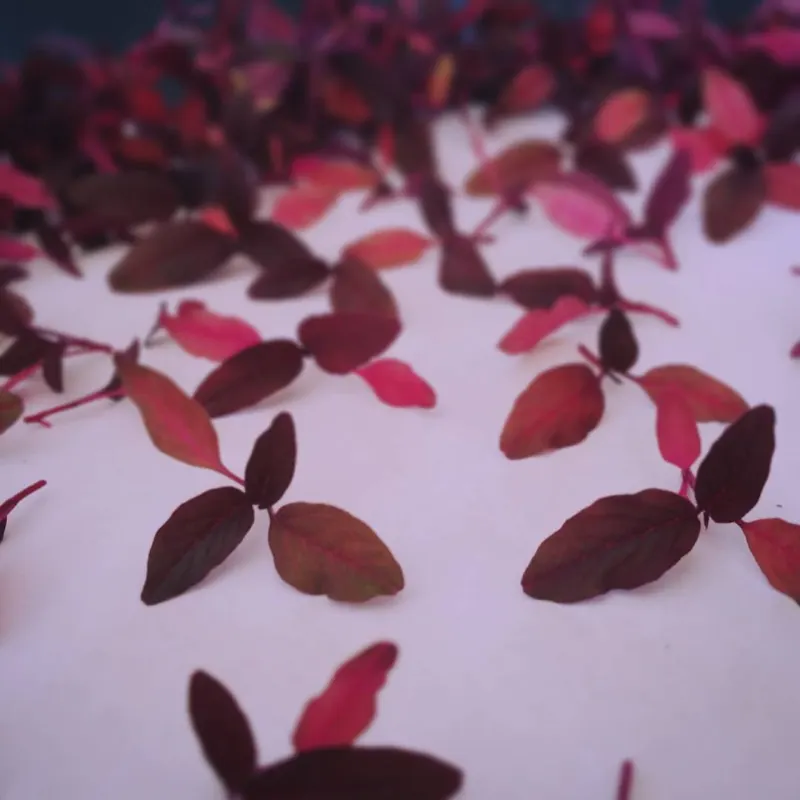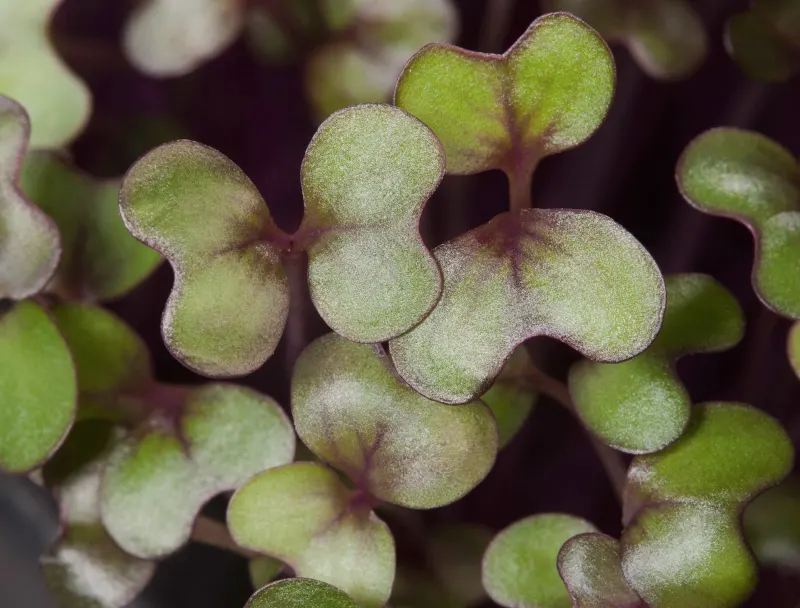
Red cabbage microgreens stand out at a glance: purple-red stems and blue-green leaves with purple tints. Their flavour is mild and fresh, with a subtle cabbage note, much sweeter than mature cabbage. Their biggest claim to fame comes from research, though: in the major USDA study of 25 varieties, red cabbage had the most vitamin C.
At a glance
| Botanical name | Brassica oleracea var. capitata (red form) |
|---|---|
| Family | Cabbage family (Brassicaceae) |
| Flavour | Mild, fresh, light cabbage note |
| Colour | Purple stems, blue-green to purple leaves |
| Presoak | Not needed |
| Days in the dark | About 2–3 |
| Harvest | About 10 days (8–12) |
| Difficulty | Easy |
The vitamin C, in numbers
In the study by Xiao and colleagues (2012), vitamin C across the 25 varieties ranged from 20.4 to 147.0 mg per 100 g, with red cabbage at the top. For comparison, the EU daily reference intake for vitamin C is 80 mg.
In practice: a generous 25 g handful provides about 37 mg, almost half the daily reference intake. Two points deserve care. First, values vary with growing conditions, harvest and storage. Second, vitamin C breaks down with heat and over time, so red cabbage microgreens give the most when eaten fresh and raw.
In a study of mice on a high-fat diet, adding red cabbage microgreens lowered "bad" LDL cholesterol and markers of inflammation. It is an interesting finding, but it comes from animals, and there are no comparable studies in people yet. There is more in our guide to what the research says about nutrition.
Growing
Red cabbage is grown like broccoli and kale, and it is ideal for beginners.
- Sow: dry seed, no soaking, thickly on a moist medium. For a 25×50 cm tray, about 25–30 g.
- Darkness: 2–3 days under a cover with a light weight.
- Light: the more light, the deeper the purple of the stems.
- Harvest: about 10 days after sowing, according to the USDA, once the cotyledons have fully opened.
Like all brassicas, it grows a lot of white root hairs in the first days, which are often mistaken for mould. See how to tell them apart.
In the kitchen
- Salads: they add colour and freshness, especially to salads with white cheeses or apple.
- On soups: on the plate, just before serving, never in the pot.
- Tacos, wraps, sandwiches: as a lighter take on shredded cabbage.
- Smoothies: their mild flavour does not mask the fruit.
A nice experiment: the purple pigments in red cabbage, anthocyanins, change colour with acidity. A little lemon juice makes them redder, while in an alkaline environment they shift towards blue.
Sources
- Xiao Z, Lester GE, Luo Y, Wang Q. Assessment of vitamin and carotenoid concentrations of emerging food products: edible microgreens. Journal of Agricultural and Food Chemistry, 2012; 60(31): 7644–7651.
- USDA Agricultural Research Service, Specialty Greens Pack a Nutritional Punch (2014).
- Huang H, et al. Red Cabbage Microgreens Lower Circulating Low-Density Lipoprotein (LDL), Liver Cholesterol, and Inflammatory Cytokines in Mice Fed a High-Fat Diet. Journal of Agricultural and Food Chemistry, 2016; 64(48): 9161–9171.
- Utah State University Extension, Grow Your Own Microgreens.
- Regulation (EU) No 1169/2011, Annex XIII: nutrient reference values.
Photo: Peggy Greb, USDA ARS, Wikimedia Commons, public domain.