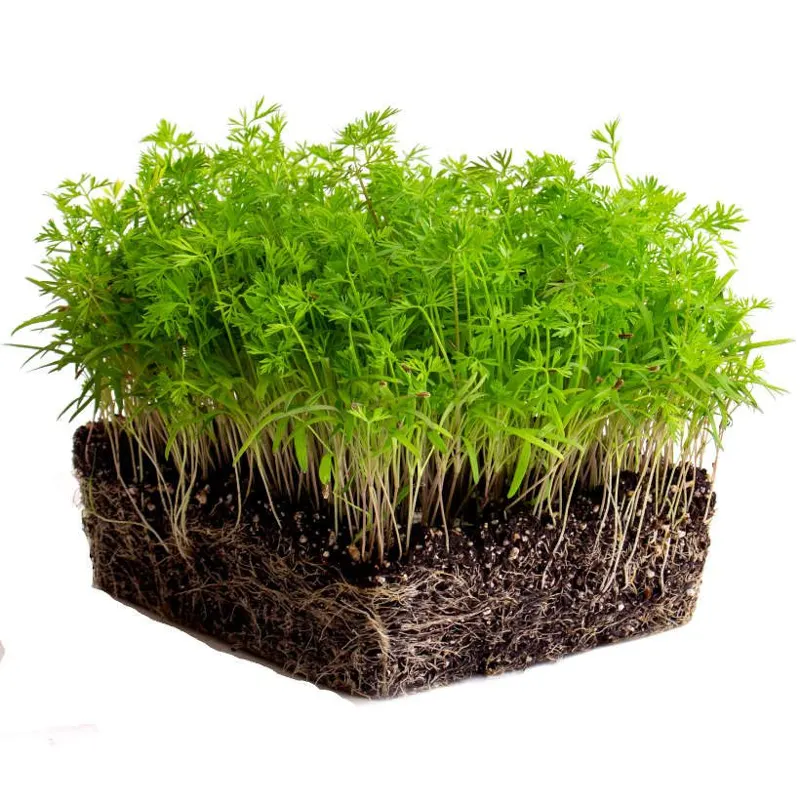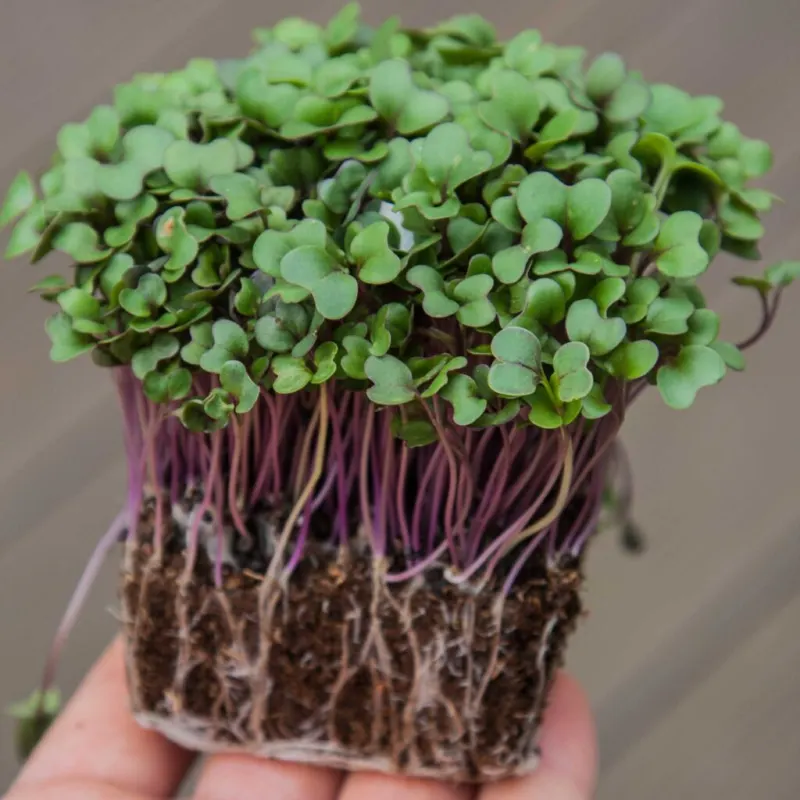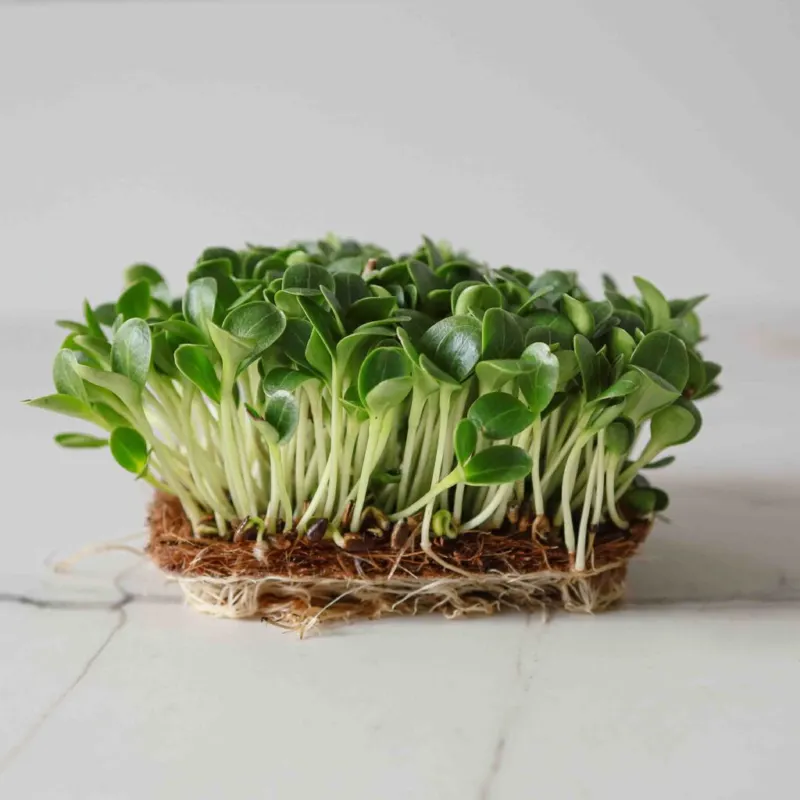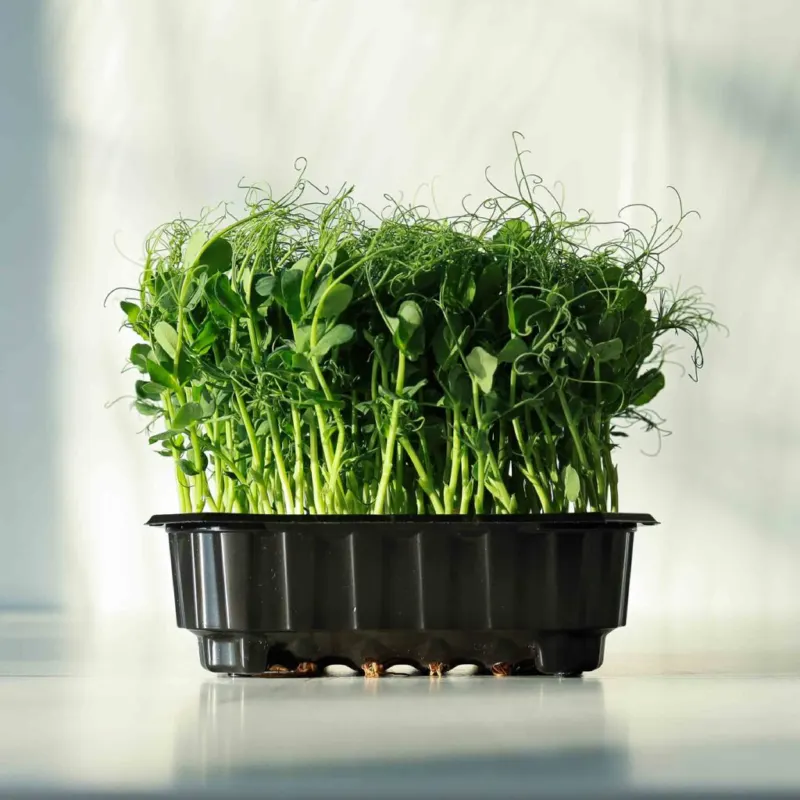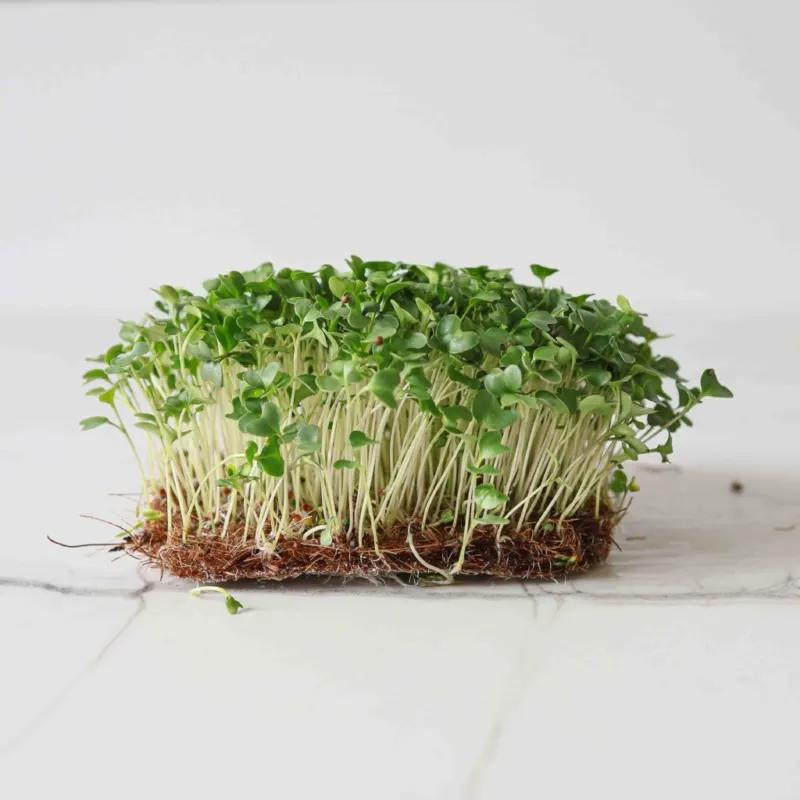
Broccoli is perhaps the most "classic" microgreen. The seedlings have white to slightly purple stems and two round, dark green, heart-shaped leaves. Their flavour is mild and fresh, with a subtle note of broccoli and far less bitterness than the mature vegetable. Calabrese is an old Italian green broccoli variety, widely used for microgreens because it germinates quickly and evenly.
At a glance
| Botanical name | Brassica oleracea var. italica |
|---|---|
| Family | Cabbage family (Brassicaceae) |
| Flavour | Mild, fresh, broccoli |
| Presoak | Not needed |
| Days in the dark | 2–4 |
| Harvest | 8–12 days |
| Seed per 25×50 cm tray | About 28 g |
| Difficulty | Easy, ideal for beginners |
What the research says
Broccoli is one of the most studied microgreens, mainly because of its glucosinolates. These are sulphur compounds typical of the cabbage family, which chewing converts into compounds such as sulforaphane.
- In a classic 1997 study, Johns Hopkins University researchers found that three-day-old broccoli sprouts contained 10 to 100 times more glucoraphanin, the precursor of sulforaphane, than mature broccoli. That study was about sprouts, not microgreens, but it explains why young broccoli plants caught scientists' interest. The same researchers note that the concentration gets diluted as the plant grows, so microgreens, cut later, would be expected to contain less than sprouts.
- According to a 2025 review, studies have found that broccoli microgreens contain more magnesium, manganese, copper and zinc than mature broccoli.
- In animal studies, broccoli microgreen juice improved weight and insulin sensitivity in obese mice. There are no studies in people yet, so we do not know whether the same applies to us.
The conversion to sulforaphane relies on a plant enzyme that heat destroys. That is why broccoli microgreens are best eaten raw. There is more in our guide to what the research says about nutrition.
Growing
- Sow: dry seed, thickly and evenly, on a moist medium.
- Darkness: 2–4 days under a cover with a light weight.
- Light and water: plenty of light, watering from below.
- Harvest: in 8–12 days, once the cotyledons have fully opened.
In the first days broccoli grows a lot of white root hairs, which are often mistaken for mould. See how to tell them apart, and the full growing guide.
In the kitchen
- Sandwiches and toast: with egg, cream cheese or avocado.
- Salads: as a base, or mixed with spicier varieties such as radish.
- Smoothies: their mild flavour goes well with apple, banana and spinach.
- On hot dishes: on soups, omelettes or pasta, on the plate rather than in the pan, so they stay raw.
Sources
- Fahey JW, Zhang Y, Talalay P. Broccoli sprouts: an exceptionally rich source of inducers of enzymes that protect against chemical carcinogens. PNAS, 1997; 94(19): 10367–10372.
- Fahey JW, Kensler TW. The Challenges of Designing and Implementing Clinical Trials With Broccoli Sprouts… and Turning Evidence Into Public Health Action. Frontiers in Nutrition, 2021.
- Kaya S, Yardımcı H. Microgreens: nutritional properties, health benefits, production techniques, and food safety risks. PeerJ, 2025.
- Utah State University Extension, Grow Your Own Microgreens.