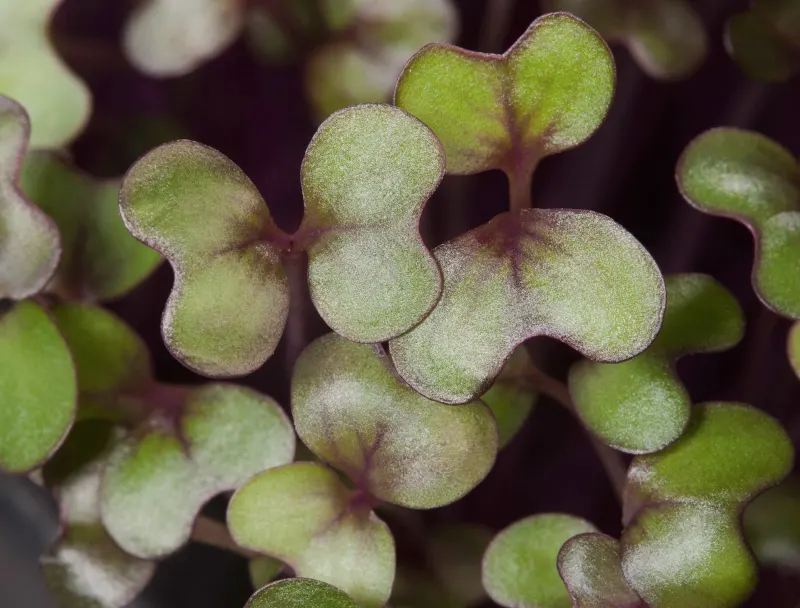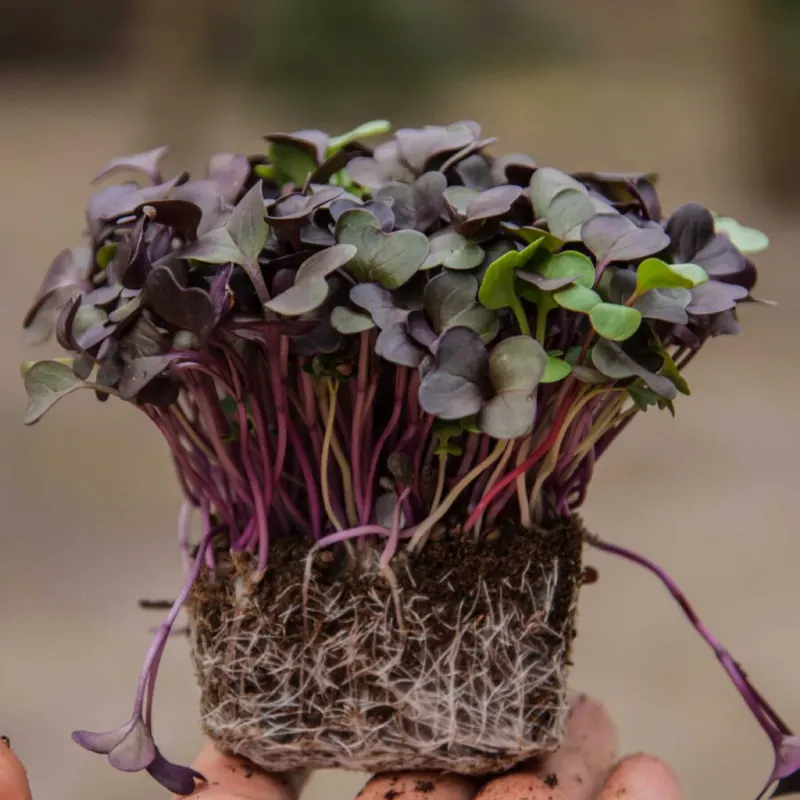
If you want to start with microgreens, radish is the best choice. It germinates in one to two days, grows quickly and almost always succeeds. The Red Rambo variety has deep purple stems and leaves, and the familiar hot, peppery radish flavour, cleaner and less earthy than the root.
At a glance
| Botanical name | Raphanus sativus |
|---|---|
| Family | Cabbage family (Brassicaceae) |
| Flavour | Hot, peppery, radish |
| Colour | Deep purple (Red Rambo) |
| Presoak | Not needed |
| Days in the dark | 1–2 |
| Harvest | 8–12 days |
| Seed per 25×50 cm tray | About 42 g |
| Difficulty | Very easy |
What the research says
Radish belongs to the cabbage family and, like broccoli, contains glucosinolates. These give it its heat and are converted into isothiocyanates, such as sulforaphane, when you chew the plant.
- A 2025 study, cited in a recent review, found that the Red Rambo variety had more sulforaphane after simulated digestion than the other radish varieties tested.
- In the major USDA study of 25 varieties, a different radish, green daikon, had the most vitamin E of all. In the USDA mineral study, daikon radish had the least potassium of the 30 varieties.
- In commercial growing, radish is one of the highest-yielding varieties per tray.
Values vary greatly between varieties and growing conditions, so we do not give a "nutrition table" for Red Rambo. See our guide to what the research says about nutrition.
Growing
- Sow: dry seed, thickly, on a moist medium.
- Darkness: only 1–2 days under a cover with a weight.
- Light: the more light, the deeper the purple. With little light the stems stay paler.
- Harvest: in 8–12 days. Left longer, they get hotter and tougher.
Radish grows lots of very visible white root hairs. They are normal, and they are the most common reason beginners think their tray has gone mouldy. See how to tell root hairs from mould.
In the kitchen
- Tacos, burgers, sandwiches: they add a kick in place of mustard or pepper.
- Salads: in small amounts, with milder varieties such as pea and sunflower.
- Egg dishes: omelettes, poached eggs or egg salad.
- Asian dishes: on ramen, noodles and sushi.
The purple shade looks lovely on pale foods such as rice, cheese and creamy soups.
Sources
- Xiao Z, Lester GE, Luo Y, Wang Q. Assessment of vitamin and carotenoid concentrations of emerging food products: edible microgreens. Journal of Agricultural and Food Chemistry, 2012; 60(31): 7644–7651.
- USDA Agricultural Research Service, Which Minerals Are in Microgreens? (2017).
- Kaya S, Yardımcı H. Microgreens: nutritional properties, health benefits, production techniques, and food safety risks. PeerJ, 2025.
- Utah State University Extension, Grow Your Own Microgreens.