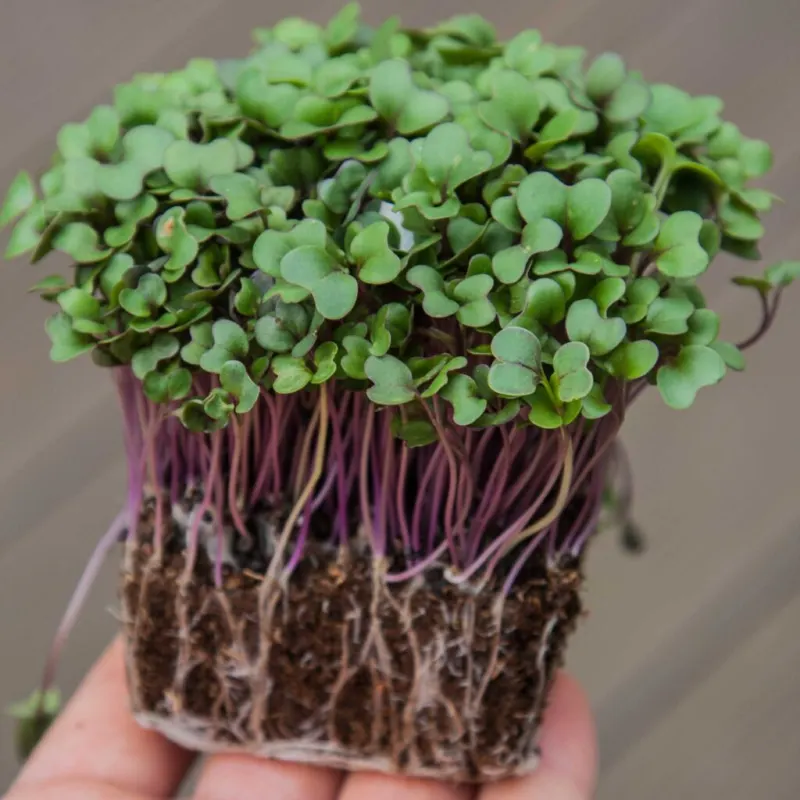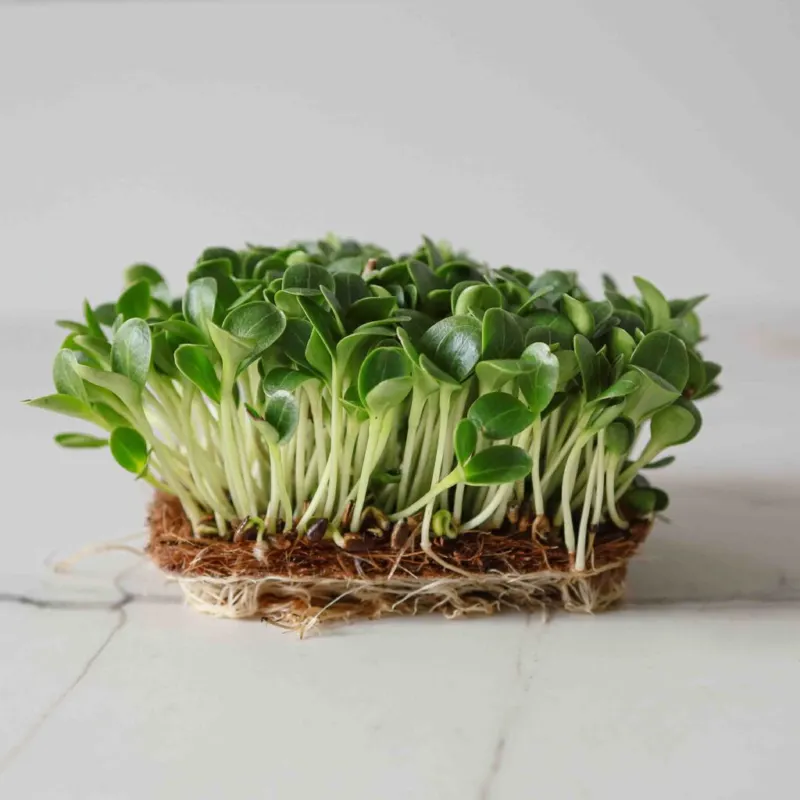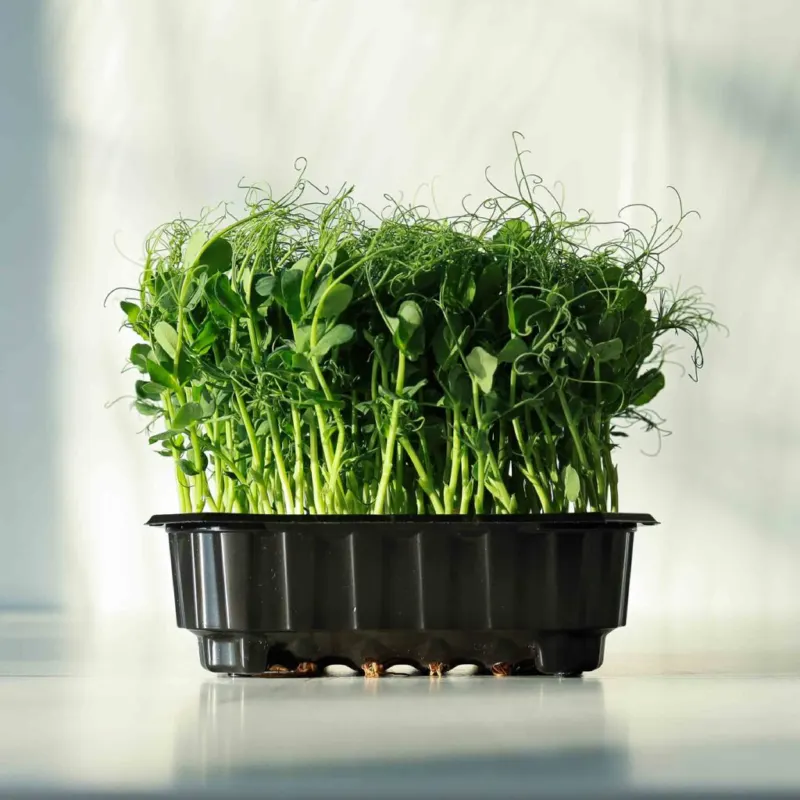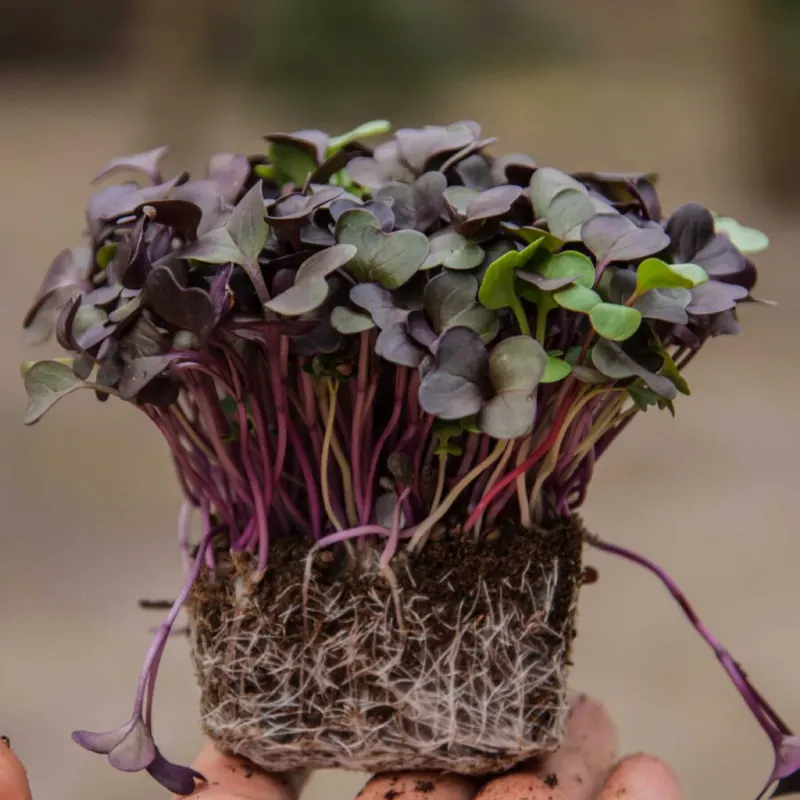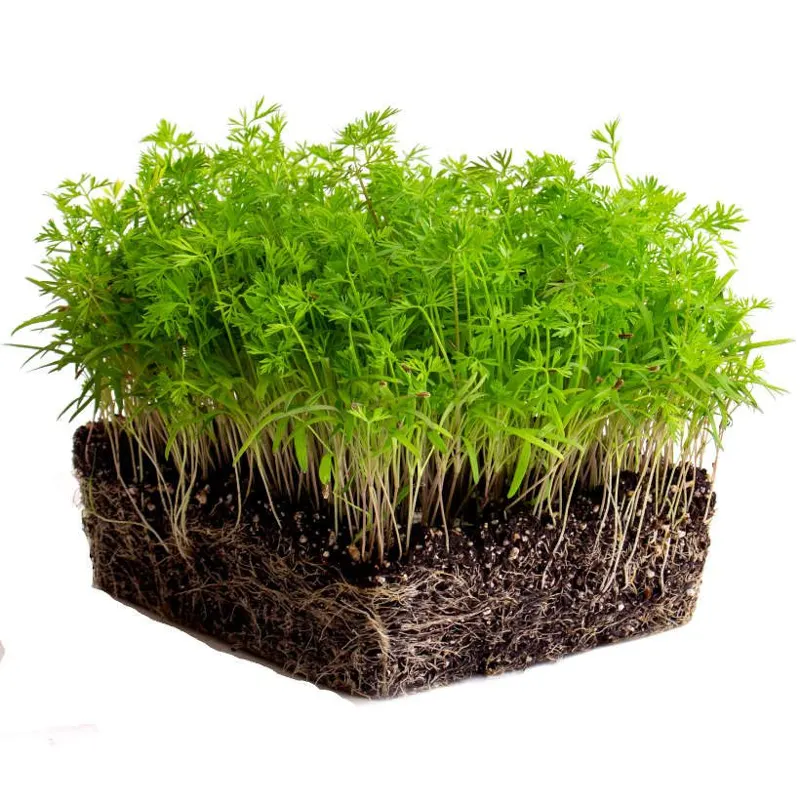
Carrot microgreens look more like tiny dill than carrot. They produce very thin stems and narrow, thread-like leaves, which in time become the carrot's familiar feathery foliage. Their flavour is mild and fresh, with notes of carrot and parsley, which makes sense, since carrot and parsley belong to the same family.
At a glance
| Botanical name | Daucus carota subsp. sativus |
|---|---|
| Family | Carrot family (Apiaceae) |
| Flavour | Mild, carrot and parsley |
| Texture | Very fine, tender |
| Presoak | Optional, helps germination |
| Harvest | Usually around 3 weeks |
| Difficulty | Moderate (slow germination) |
Growing
Seeds of the carrot family, such as carrot, parsley and coriander, are known to germinate slowly. For comparison, Utah State University gives 21–28 days to harvest for coriander, against 8–12 for most brassicas. Carrot falls somewhere in between, closer to the slow varieties.
- Soak: a few hours in water help it germinate faster and more evenly.
- Sow: thickly, on a fine, moist medium.
- Darkness: several days, until most seeds have germinated. Do not let the medium dry out during this time: it is the most common cause of failure.
- Light: after germination, plenty of light so the thin stems do not lean.
- Harvest: once the first feathery leaves have developed, usually around 3 weeks. Cut with sharp scissors, because the thin stems crush easily.
See the growing guide and the common problems, especially for patchy germination.
Nutrition
Carrot root is famous for beta-carotene. Microgreens are leaves, not roots, though, and reliable published data specifically on carrot microgreens are limited. So we do not give per-100 g figures. It is worth noting that in the major USDA study, coriander, a relative in the same family, had the most carotenoids, but that does not mean the same is true of carrot. See our guide to what the research says.
In the kitchen
- Garnish: their fine, lacy texture suits fish, seafood, carpaccio and soups.
- Salads: mixed with crunchier varieties such as sunflower and pea.
- Carrot dishes: on roast carrots or carrot soup, for a "root to leaf" plate.
- In place of parsley: in tabbouleh, yoghurt sauces or omelettes.
Sources
- Utah State University Extension, Grow Your Own Microgreens.
- Xiao Z, Lester GE, Luo Y, Wang Q. Assessment of vitamin and carotenoid concentrations of emerging food products: edible microgreens. Journal of Agricultural and Food Chemistry, 2012; 60(31): 7644–7651.
- Penn State Extension, The ABCs of Microgreens.