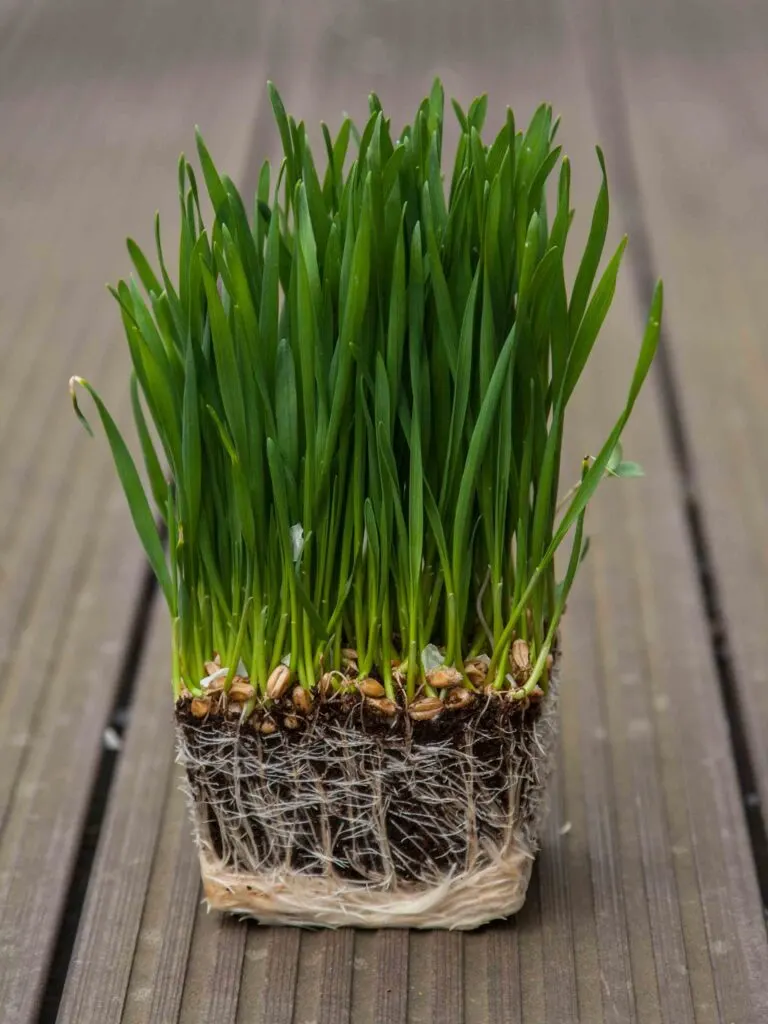
Wheatgrass is the young leaves of common wheat, cut a few days after germination. It became famous as a juice "shot" in juice bars, and today many people grow it at home. It differs from most microgreens: its leaves are thin, long and fibrous, with a strong, sweet "fresh-cut grass" flavour. That is why it is usually juiced rather than eaten in salads.
At a glance
| Botanical name | Triticum aestivum |
|---|---|
| Family | Grass family (Poaceae) |
| Flavour | Sweet, strong, "grassy" |
| Texture | Fibrous, for juice or smoothies |
| Presoak | Yes, usually 8–12 hours |
| Harvest | Usually 7–10 days, at 10–15 cm |
| Difficulty | Easy |
Growing
- Soak: whole wheat berries (not hulled or pearled) in water for 8–12 hours.
- Sow: thickly, in a single layer, on a moist medium.
- Darkness: 2–3 days under a cover, until the first shoots show.
- Light and water: a bright spot, watering from below. Wheat moulds easily if the seeds stay soggy, so airflow matters.
- Harvest: when the grass is about 10–15 cm tall, before it starts to split into a second blade. Cut with scissors just above the seeds.
It often gives a second cut, though thinner and more fibrous. See the full growing guide and the guide to mould.
The health claims: what holds up
Wheatgrass comes with many claims: that it "detoxes", that its chlorophyll "cleans the blood", that one shot equals kilos of vegetables. The honest answer is that there are no good studies in people to support them.
- The body "detoxes" itself, through the liver and kidneys. No food has been shown to speed this up.
- Chlorophyll is the green pigment of all green plants, not something unique to wheatgrass.
- The small studies that exist are few, with few participants, and do not allow firm conclusions.
Wheatgrass is a green leafy vegetable. Like all greens, it provides vitamins, minerals and plant compounds, and it is a pleasant way to get more green into your day. It is not a miracle, though. For what we actually know about microgreens, see our guide to what the research says.
How to use it
- Juice: in a slow (masticating) juicer. Ordinary centrifugal juicers get almost nothing out of the thin blades.
- Smoothies: chopped into a blender with fruit such as pineapple, apple or banana, which masks its strong flavour. Strain it if the fibres bother you.
- In sauces: a little, finely chopped, in pesto or green sauces.
Sources
- Penn State Extension, The ABCs of Microgreens.
- Kaya S, Yardımcı H. Microgreens: nutritional properties, health benefits, production techniques, and food safety risks. PeerJ, 2025.