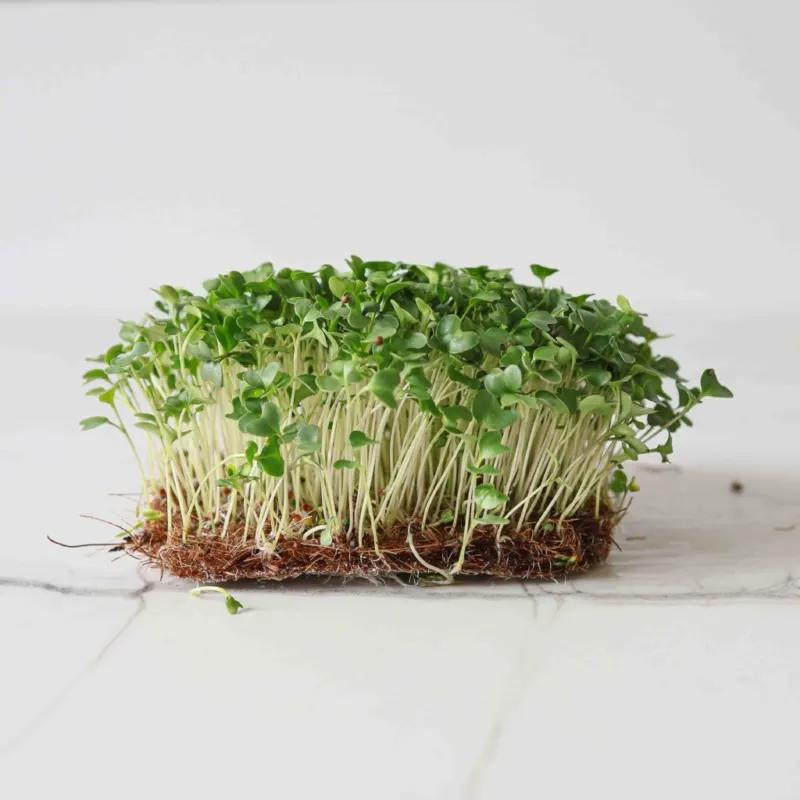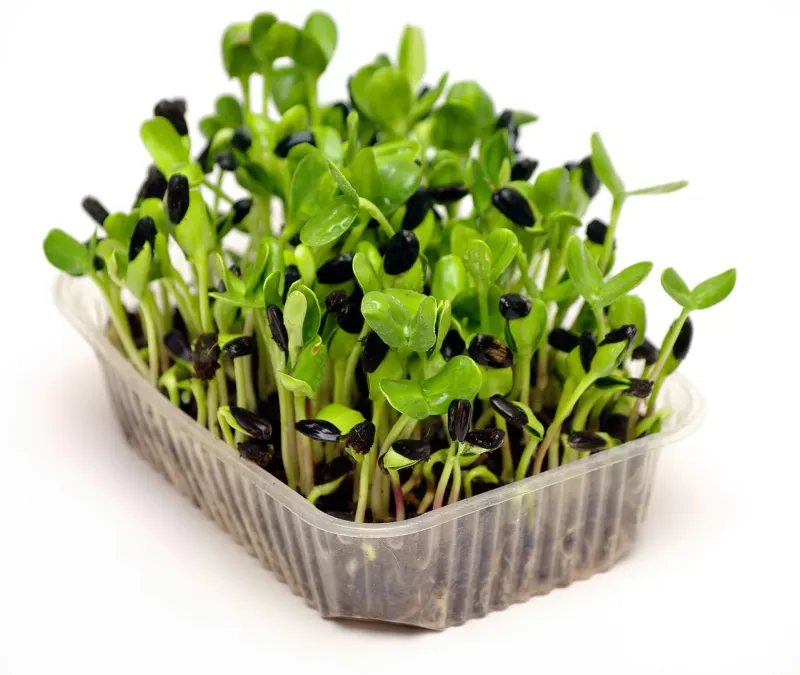
Sunflower microgreens are among the most popular, and with good reason. They have a thick, juicy stem, two fleshy green leaves and a sweet flavour reminiscent of nuts. They are so crunchy that many people eat them on their own as a snack. They are also one of the more filling microgreens, so they work when you want bulk in a salad rather than just a garnish.
At a glance
| Botanical name | Helianthus annuus |
|---|---|
| Family | Daisy family (Asteraceae) |
| Flavour | Sweet, nutty |
| Texture | Very crunchy, juicy |
| Presoak | About 12 hours |
| Days in the dark | About 3 |
| Harvest | 9–10 days |
| Seed per 25×50 cm tray | About 48 g |
| Difficulty | Moderate (watch for mould and stuck hulls) |
Growing
For microgreens, growers usually use black sunflower seeds still in their hulls, sold specifically for sprouting and microgreens. Hulled snack seeds germinate poorly, and roasted ones not at all.
- Soak: put the seeds in water for about 12 hours. Many growers then leave them in a colander for a few more hours until the first roots show.
- Sow: spread them densely, in a single layer, on a moist medium.
- Darkness with weight: cover them and add a weight for about 3 days. The weight does not just help the roots: it also helps the plants leave the hard hull behind as they push upwards.
- Light and watering: water from below, with good airflow. Sunflower is one of the varieties that moulds most easily if the medium stays soggy.
- Harvest: after about 9–10 days, once the two cotyledons have opened. Cut before the first true leaves appear, because after that the texture toughens and the flavour turns more bitter.
Hulls left on the leaves come off if you brush a palm lightly across the tray, or when you rinse them. There is more on the method in the home growing guide, and on mould in the common problems guide.
Nutrition
Sunflower seed is rich in fat and protein, and the young plants keep some of this. A recent study cited in a 2025 review looked at the lipids in sunflower microgreens, but reliable published data on vitamins and minerals for this particular variety are still limited. That is why we do not give per-100 g figures here. If you see precise tables online with no source, treat them with caution. For the general picture, see our guide to what the research says about nutrition.
In the kitchen
- Salads: as a base, not just a garnish. They go well with citrus, avocado and roasted vegetables.
- Sandwiches and wraps: they add crunch in place of lettuce.
- Grain bowls: on top of rice, quinoa or bulgur.
- Snack: plain, or with a little salt and lemon.
- Hot dishes: add them at the very end, to a vegetable stir-fry or pasta, just before serving, so they stay crunchy.
What to watch for
If you are allergic to sunflower seeds, avoid the microgreens too. Otherwise, the general rules for any raw vegetable apply: see the storage and food safety guide. In the fridge, sunflower is one of the hardiest microgreens.
Sources
- Utah State University Extension, Grow Your Own Microgreens (seed amount, soaking, days in the dark and to harvest).
- Kaya S, Yardımcı H. Microgreens: nutritional properties, health benefits, production techniques, and food safety risks. PeerJ, 2025.
Photo: Pannet, Wikimedia Commons, CC BY 4.0.